Research
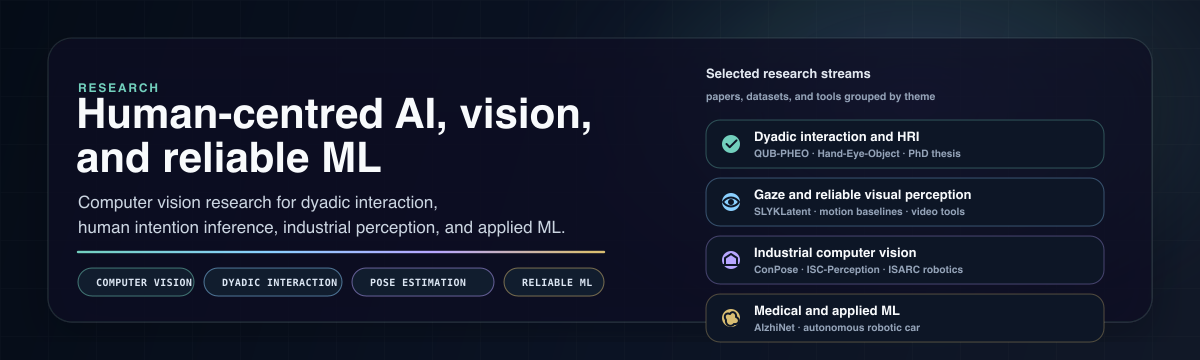
I work across computer vision, dyadic interaction, human intention inference, and reliable applied ML, with a focus on research that can move toward real-world AI systems.
Research map: Computer Vision · Dyadic Interaction · Human-Robot Collaboration · Gaze Estimation · Industrial Perception · Reliable ML
At a Glance
| Theme | Selected outputs |
|---|---|
| Dyadic Interaction and HRI | PhD thesis · QUB-PHEO · Hand-Eye-Object Tracking |
| Gaze and Visual Perception | SLYKLatent · Dyadic Motion Prediction |
| Industrial Computer Vision | ConPose · ISC-Perception · ISARC Robotics Strategy |
| Medical and Applied ML | AlzhiNet · Autonomous Robotic Car |
| Datasets and Tools | QUB-PHEO Dataset · QUBVidCalib · aVerify · Ormedian-Utils |
Dyadic Interaction and Human-Robot Collaboration
Research on how visual cues such as gaze, hands, objects, and motion can support human intention inference in collaborative assembly.
| Work | Venue / year | Links |
|---|---|---|
| Deep Learning of Dyadic Interaction Visual Cues for Human-Robot Collaboration | PhD thesis, Queen's University Belfast, 2024 | Thesis |
| QUB-PHEO: A Visual-Based Dyadic Multi-View Dataset for Intention Inference in Collaborative Assembly | IEEE Access, 2024 | Paper · Dataset · arXiv |
| Hand-Eye-Object Tracking for Human Intention Inference | IFAC-PapersOnLine, 2022 | Paper |
| Dyadic Human-Robot Interaction: Emerging Technologies, Challenges, and Opportunities | Book chapter, 2025 | Chapter |
| Establishing Baselines for Dyadic Visual Motion Prediction Using the QUB-PHEO Dataset | IFAC-PapersOnLine, 2025 | Paper |
Related artifacts: QUB-PHEO Dataset · PHEO Zenodo Dataset · QUB-PHEO Preprocessing Repository
Gaze, Visual Cues, and Reliable Perception
Work on gaze estimation, facial feature learning, visual signal modelling, and robust human-centred perception.
| Work | Venue / year | Links |
|---|---|---|
| SLYKLatent: A Learning Framework for Gaze Estimation Using Deep Facial Feature Learning | IEEE Transactions on Human-Machine Systems, 2025 | Paper · arXiv |
| Hand-Eye-Object Tracking for Human Intention Inference | IFAC-PapersOnLine, 2022 | Paper |
| Establishing Baselines for Dyadic Visual Motion Prediction Using the QUB-PHEO Dataset | IFAC-PapersOnLine, 2025 | Paper |
Related tools: QUBVidCalib · aVerify
Industrial Computer Vision and Robotic Assembly
Applied vision systems for object detection, RGB-only 6-DoF pose estimation, synthetic-to-real perception, and robotic assembly workflows.
| Work | Venue / year | Links |
|---|---|---|
| ConPose: A Jointly Trained, Single-Pass RGB Detection-and-Pose Framework for Intermeshed Steel Connections | Machine Vision and Applications, 2026 | Paper |
| ISC-Perception: A Hybrid Computer Vision Dataset for Object Detection in Novel Steel Assembly | Preprint, 2025 | arXiv |
| A Proposed Strategy for Automating Intermeshed Steel Connection Assembly using Robotics | ISARC, 2025 | Paper |
Related tools: QUBVidCalib · aVerify · Ormedian-Utils
Medical and Applied Machine Learning
Deep learning for diagnostic imaging and applied intelligent systems.
| Work | Venue / year | Links |
|---|---|---|
| AlzhiNet: Traversing from 2D-CNN to 3D-CNN, Towards Early Detection and Diagnosis of Alzheimer's Disease | Interdisciplinary Sciences: Computational Life Sciences, 2026 | Paper · arXiv |
| Application of Deep Learning to Autonomous Robotic Car | International Journal of Computer Applications, 2021 | Paper |
Research Software and Utilities
Tools and utilities supporting data preparation, calibration, annotation verification, and reusable computer vision workflows.
| Tool | Use |
|---|---|
| QUB-PHEO Dataset | Multi-view dyadic interaction dataset for collaborative assembly research. |
| QUBVidCalib | Video calibration and correction toolbox for multi-view workflows. |
| aVerify | Video annotation verification tooling. |
| Ormedian-Utils | Computer vision utility package. |
Full Publication List
For the full and current list, see my Google Scholar profile.